
The Beauty of Noravank Monastery in Armenia.
I visited a Armenia a couple of years back. We were on a roundtrip by bus. Armenia is a fascinating country, and even if it is a small country, they have an incredibly strong history, and many ‘Worlds first’ or ‘Worlds largest’.
The Monastery of Noravank is among the most beautiful monasteries we saw. The road to get there is up through a canyon, and the road ends by the monastery. You might ask, why monks went to so solitude areas to live and study.

The Canyon leading to Noravank monastery.
Halfway up the canyon, there’s a small restaurant built into the cave, where we had lunch, before going the rest of the way up.
This photo from Haghpat Monastery is another of my favorite photos from Armenia.

The Sun is Setting by Church in Armenia.
If you find my articles interesting and like post-processing images. Consider getting AuroraHDR, it’s a full fletched image processing tool, for editing not only HDR photos but also normal photos.
Please use the link on my webpage and support me that way. I only recommend software and tools that I use.
I am not ‘bought’ to say nice things with sugar on top. I say what I think and feel about products. I get nothing for writing these articles, but I do get a kickback if you use my link to buy AuroraHDR, as well as if you use my 15% discount coupon code “caughtinpixels” for buying Buy Photomatix Pro. Thanks.
If you like my work, why not follow me on Twitter, Facebook, and Google+. I post photos daily.
–Jacob Surland
]]>
The Monastery of Haghpat is a UNESCO World Heritage site in Armenia worth a visit.
Over the past six months, I have thought a lot about, what it is that I do with my photography. What is it I like to do? And what I don’t like to do? My available time for photography is limited, and I want to spend my time on the right things.
I have to admit, that I love the post-processing much more than the actual shooting of the photos. And when I shoot, I am looking forward to the post-processing. This has become more and more clear to me. A logical consequence of that is that I put time into learning new and interesting post-processing techniques, and combining them in new ways.
I once asked a professional traditional landscape photographer, if he considered himself a photographer or an artist. He promptly said ‘Photographer’, and then I asked what the difference was, and the answer to that, was somewhat more unclear. My conclusion was that he ‘felt’ a photographer because he recorded reality, as real and natural as possible.
When I started out, I asked myself a similar question: ‘Am I an artist? Or am I a photographer?’ and then the next question was, ‘What is an artist, anyway?’
I have come to the conclusion that I am an artist without a doubt. Why? First of all, because I feel that way, but also because I try to make something that I like, from the components I have. I try to carry an image, to where my imagination can carry it, and to the extent of the potential of the image. The components I have at hand are my RAW files, Lightroom, Photoshop and various other tools and techniques. Some photos have much more potential, than other photos. The ones with a lot of potential in the creative sense are the photos I like the most.
I create an alternative surreal reality, rather than record reality. I am no documentarian. I do what I do, because I like to do it that way and pay no heed to what reality looked like. And that is the essence of why I feel that I am an artist.
Many photographers, don’t like what I do because I manipulate my photos, but to me that isn’t important. I do what I do, because I love to do it, not because somebody else should like it. Does anyone happen to like it, I am just more happy.
About this particular image
I felt particularly artistic when I made this photo. The vision of this final image evolved as I worked on the image. The initial image, of Monastery of Haghpat, had an almost blown out sky and lacked the warm feeling. I did, however, like the composition a lot.
My first idea was to find a sunrise or sunset photo, having clouds in the shape of a bow, like the arrow, suggests.
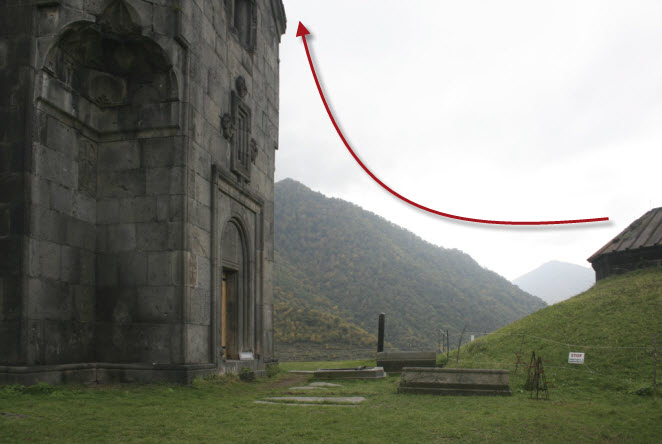
I found this image, which I flipped to match the curve:
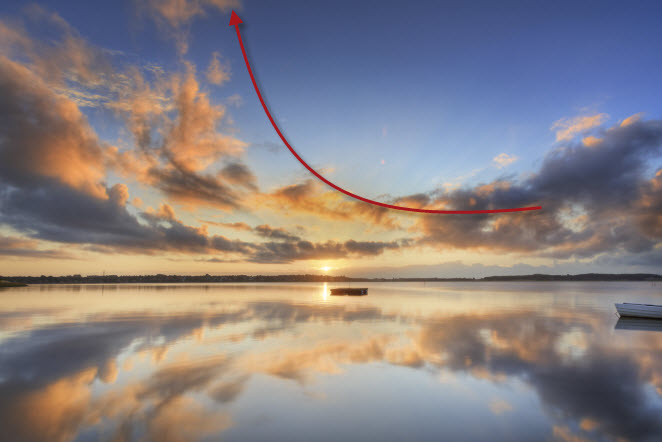
When I had merged the two, an idea began to form itself. The light from the two didn’t fit too well. I then applied textures (read about applying textures in this blogpost) to the image, which brought the warm feeling to the monastery and gave a more homogene warm feeling to all over the image.
I cleaned up the image. Removed the dead pigeon, and the fencing, etc. Cleaning up is an important step, and you will be amazed how much you can change an image, just by removing irrelevant stuff in your image.
I still had the feeling, that I was missing something, and I began looking for birds and found this one from Grand Canyon. I flipped it, to look at the entrance.

]]>
 Armenia lies in a very seismic active area. They are the first nation ever (!) to become a Christian Nation, which happened around 300 AD. They have a lot of these small very beautiful compact churches spread all over the country. They are compact to withstand the earth quakes. Armenia is not only the first Christian nation, but they also invented color television and even more important: they invented red wine, some 8000 years ago.
This is the Monastary Noravank, one of the most beautiful monasteries they have got.
The photo is a single RAW file, taken with my old Canon 400D and the kit lens at 18mm. I did two virtual copies in Lightroom, and changed the exposure of the two to -2 and +2, so that I had exposures (-2, 0 and +2). I then worked on the noise and sharpened a bit, before I took them into Photomatix. I then took it to Photoshop CS6, used Topaz and did worked a bit with blending the exposures with the tonemapped image. And finally I cloned out a couple of things. ]]>